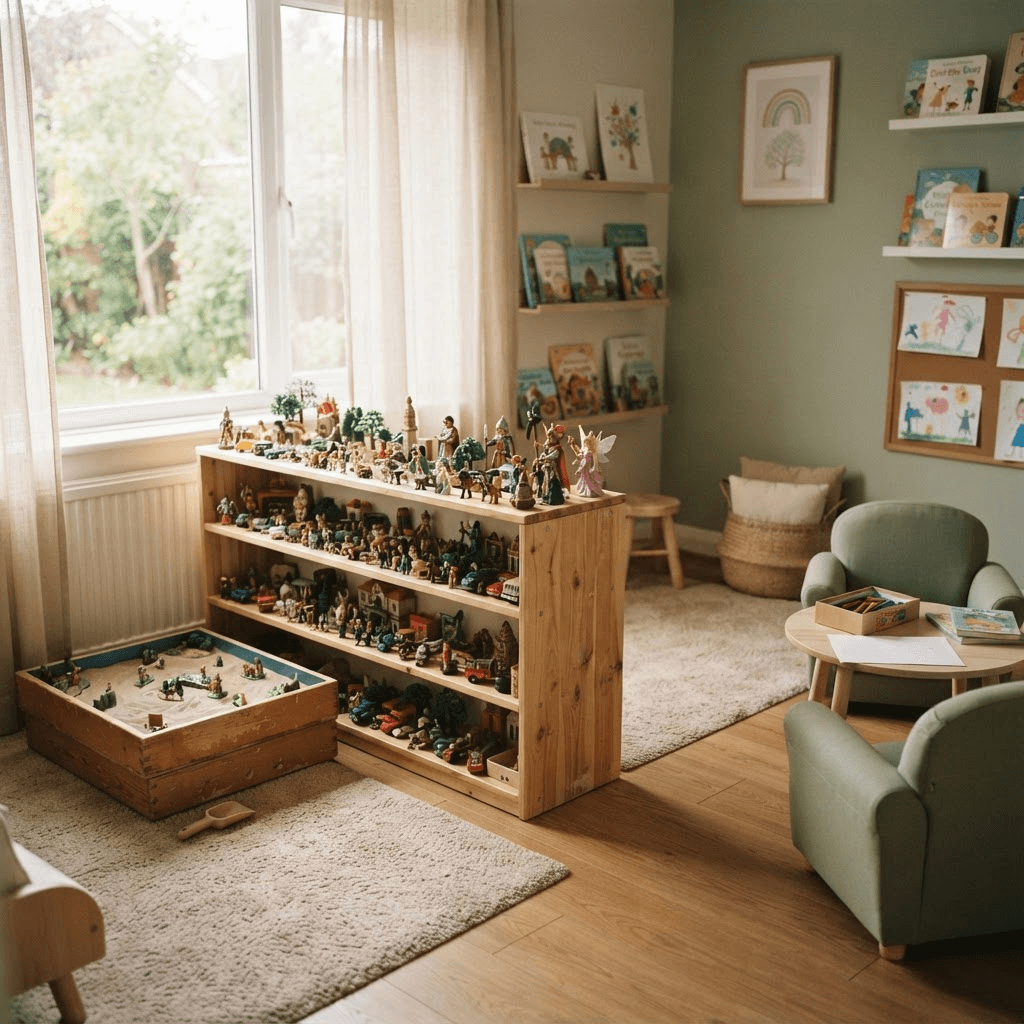
There's a moment that happens in almost every play therapy session I've had with a child, somewhere in the first few weeks. We're playing — maybe they're building something in the sandtray, maybe they've picked up a family of animal figures and started moving them around without quite realizing it — and something shifts. A little more ease comes into their body. The thing they couldn't tell me, they start showing me.
That moment is exactly what play therapy is for.
Why Children Can't Just "Talk About It"
When adults are struggling, we can usually sit down with someone and say: here's what happened, here's how I feel about it, here's what I can't figure out.
Children don't work that way. Not because they aren't smart or perceptive — often they are startlingly perceptive — but because their brains are still developing the language and the cognitive scaffolding to put experience into words. When something hard happens to a child, it doesn't sit neatly in their memory waiting to be narrated. It lives in their body. It comes out in their play, their drawings, their behavior, their dreams.
Play is the language children already speak. When I meet a child there — in the sand, in the figures, in the story — I'm speaking their language. Not asking them to speak mine.
What Play Therapy Actually Looks Like
People sometimes picture play therapy as a child playing while a therapist watches from across the room and takes notes. That's not quite it.
Play therapy is active and relational. I'm in the room with the child, following their lead, noticing what they're creating and communicating, and sometimes — gently, carefully — entering the story with them. A child who's been through something frightening might play it out again and again, but with a different ending. A child who doesn't feel safe at home might build a sandtray world where the house is surrounded by protection on every side. A child who has learned to hold everything together might finally let a character in their play fall apart — and discover that it's okay.
There's a lot happening underneath that looks, from the outside, like two people playing.
The Kids I Work With
I come to play therapy from a background in ABA work with autistic kids, and that history shapes how I do this work. I learned to follow a child's lead before I ever learned the term "person-centered." I learned that connection comes before compliance, always.
I work with a wide range of kids — children who are anxious, children processing family changes or loss, children who've experienced trauma, children who've been described as "too much" or "shut down" or "unreachable." I work with neurodivergent kids for whom a standard talking-therapy format would never work, and where play opens a door that nothing else has.
What I've found, again and again, is that kids who seemed unreachable weren't unreachable at all. They were waiting for someone to show up in a way they recognized.
What Parents Notice
Parents often ask me: how will I know it's working? The answer is usually not "they'll come home and tell you what they talked about." It's subtler than that.
It shows up as a child who was rigid becoming more flexible. A child who was explosive having a slightly longer fuse. A child who came home from school silent and defeated starting to say a sentence or two about their day. Sometimes it's just a little more ease in the house — a different quality to the air.
The work that happens in those fifty minutes ripples outward. I often work with parents alongside the child, because what a child learns in the therapy room needs somewhere to land. When parents understand what their child has been communicating — in their behavior, in their play, in the way they push everyone away — the whole relationship has a chance to shift.
A Note on Trust
The most important thing I can offer a child is a room where they are completely safe to be exactly who they are. Not the version of themselves that's holding it together for the adults around them. Not the version that knows what they're "supposed" to feel. The real one.
That takes time. It takes showing up the same way, session after session, until a child starts to trust that this room is actually different — that nothing they bring here will be used against them, that they won't be managed or redirected away from the hard thing, that someone can sit with whatever they carry without flinching.
Once that trust is there, the work moves. Almost always.
If your child is going through something — if you sense they're carrying more than they can say — I'd love to connect. This is some of the most meaningful work I do, and I take the privilege of it seriously.
Tags
Free guide for parents
The Family Foundations Guide
Five family meetings to name what your family stands for, so rules make sense and consequences stop feeling like power struggles.
Need support for your family?
Schedule a free 15-minute consultation with one of our therapists.
Get Started